
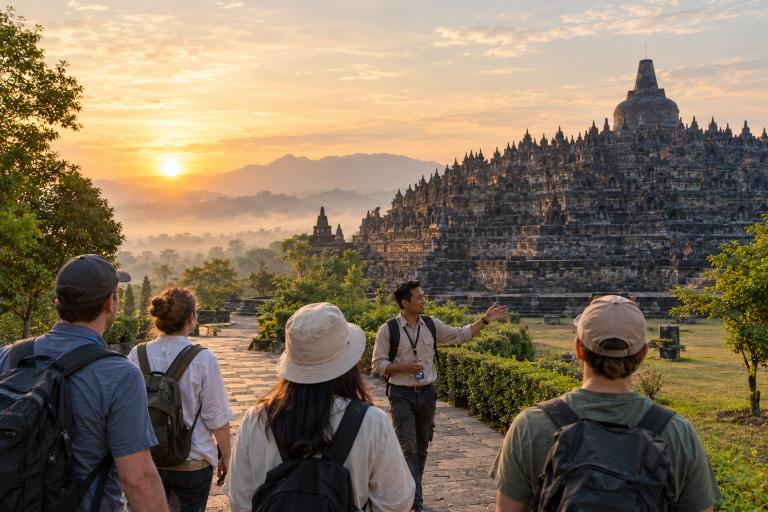
A Borobudur Cultural Experience invites travelers to look beyond the monument’s appearance and explore the beliefs, artistic traditions, and historical ideas connected with it. Rather than treating the visit as a single photo stop, take time to listen, observe, and ask questions about the cultural meaning of what you see.
Begin by considering what you want to understand. Your interests might include Buddhist symbolism, storytelling through reliefs, conservation, or the relationship between heritage and contemporary communities.
Borobudur Cultural Experience: Understand the Setting
Borobudur was built during the eighth and ninth centuries under the Syailendra Dynasty. UNESCO recognizes the temple compounds as an outstanding expression of Buddhist art and architecture in Central Java. Understanding this background gives the visit a clearer historical foundation.
The monument belongs to a particular cultural setting, not simply a broad category of ancient temples. Ask your guide to explain how its design relates to Buddhist ideas and the artistic traditions of Java.
This context helps connect architectural details with the people and beliefs behind their creation.
Explore Stories through the Reliefs
Borobudur’s carved reliefs form an important part of its cultural meaning. UNESCO describes the monument’s decoration as an expression of Buddhist teachings and the journey toward spiritual understanding.
Rather than trying to examine every panel, ask your guide to select examples and explain their narratives. Look at how figures, gestures, and settings contribute to the story.
Allow time for questions. A careful explanation of a few scenes can offer more insight than moving quickly past many carvings without context.
Listen to Local Perspectives
Make conversation part of your Borobudur Cultural Experience. Ask your guide how the site is interpreted, protected, and experienced today.
Distinguish documented history from local traditions and personal interpretations. Each can add interest, but they should not be presented as the same kind of evidence.
If your itinerary includes community activities or workshops, ask who organizes them and what visitors are invited to do. Choose experiences that explain their purpose clearly.
Practice Respectful Cultural Travel
Approach the site with the awareness that it carries religious as well as historical significance. Follow visitor instructions and avoid treating sacred imagery as a prop.
Ask permission before photographing people. If you encounter worship or ceremonial activity, give participants space and follow guidance about appropriate behavior.
When visiting a workshop or community setting, listen before participating. Avoid assuming that every cultural activity is open for unrestricted photography.
Connect Appreciation with Preservation
The monument’s survival also forms part of its cultural story. UNESCO coordinated an international restoration effort from 1973 to 1983, demonstrating the scale of work required to safeguard Borobudur
Ask how visitor behavior contributes to protecting the site. Following designated routes and respecting access restrictions are practical ways to approach heritage responsibly.
Leave with a Deeper Understanding
A meaningful Borobudur Cultural Experience combines historical context, thoughtful observation, and respectful interaction.
Choose an itinerary that provides time for explanation rather than only movement between stops. The aim is not to see everything, but to understand more clearly how art, belief, history, and preservation connect.