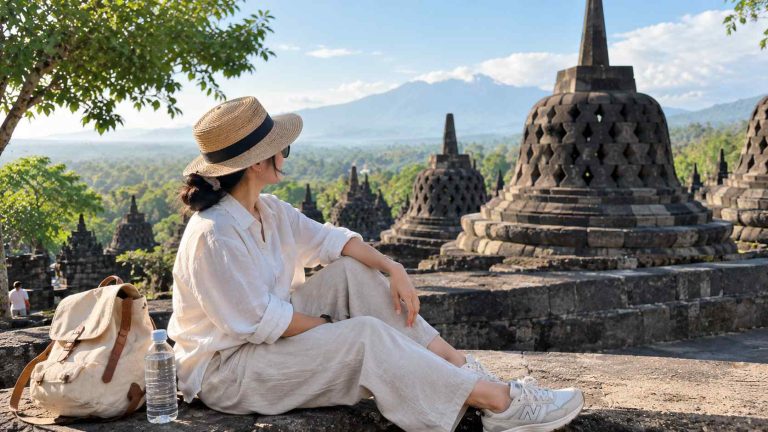



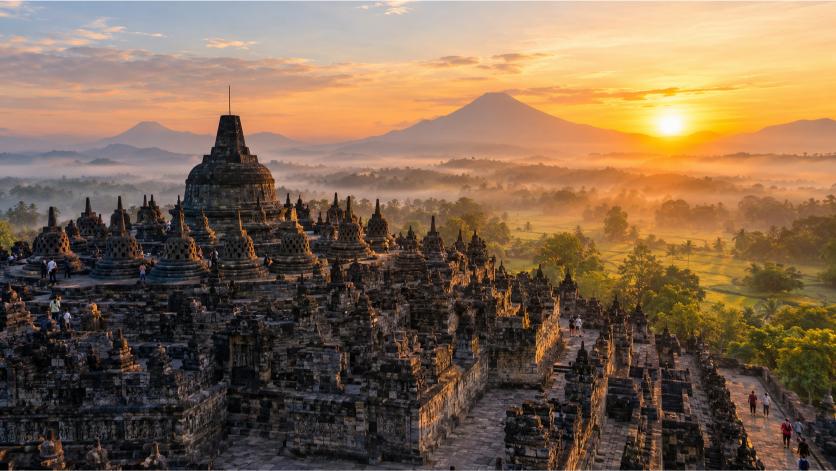
Borobudur is one of the most remarkable Buddhist monuments in the world. Understanding Borobudur temple history helps you appreciate its beauty and meaning.
Located in Magelang, Central Java, Borobudur is a UNESCO World Heritage Site. It attracts millions of visitors every year.
This guide explores the history of Borobudur. It covers its origins, purpose, and restoration.
Origins of Borobudur
Borobudur was built during the Sailendra dynasty. This dynasty ruled parts of Java around the 8th and 9th centuries.
The temple was constructed between the 8th and 9th centuries. It took decades to complete.
Borobudur was built as a Buddhist monument. It was designed to represent the path to enlightenment.
The temple’s design reflects Buddhist cosmology. It symbolizes the journey from the earthly world to spiritual awakening.
The Design of Borobudur
Borobudur is built in the shape of a mandala. This represents the universe in Buddhist tradition.
The temple has nine platforms. These include six square terraces and three circular platforms.
At the top sits a large central stupa. This symbolizes the ultimate goal of enlightenment.
The walls are covered with relief panels. These carvings tell stories from Buddhist teachings.
There are more than 2,000 relief panels. They depict scenes from daily life, spiritual lessons, and Buddhist stories.
The Purpose of Borobudur
Borobudur was built as a place of worship. It was also a pilgrimage site for Buddhists.
Pilgrims would walk around the temple in a clockwise direction. This ritual is known as pradakshina.
As they walked, pilgrims would pass the relief panels. Each panel told part of the spiritual journey.
The temple was designed to guide visitors toward enlightenment. The higher you climb, the closer you get to spiritual awakening.
The Decline and Rediscovery
Borobudur was abandoned around the 14th century. The reasons are still debated by historians.
Some believe volcanic eruptions played a role. Others point to the shift of power in Java.
The temple was covered by volcanic ash and jungle. It remained hidden for centuries.
Borobudur was rediscovered in the 19th century. British colonial ruler Thomas Stamford Raffles played a key role.
After its rediscovery, efforts began to restore the temple. This was a massive undertaking.
The Restoration of Borobudur
The most famous restoration took place between 1973 and 1983. This project was supported by UNESCO and the Indonesian government.
The restoration involved dismantling and rebuilding parts of the temple. Experts worked to preserve the original stones.
The project took over a decade to complete. It was one of the largest restoration efforts in the world.
In 1991, Borobudur was designated a UNESCO World Heritage Site. This recognized its cultural and historical importance.
Today, Borobudur is carefully protected. Visitor access is managed to preserve the monument.
Final Thoughts
Borobudur temple history is a story of faith, art, and resilience. From its origins in the 8th century to its restoration in modern times, the temple has a rich past.
Visiting Borobudur is more than sightseeing. It is a journey through history and spirituality.
For the latest schedule and access details, check the complete guide to Borobudur opening hours from Borobudur Tours.
With good planning, Borobudur can be one of the most memorable highlights of your trip to Indonesia.